
Employee Rights in California After Being Fired: What the Law Protects
Fired employees in California have clear legal rights that begin on the last day of employment. California law covers final pay, health insurance continuation, unemployment benefits, and full protection against wrongful termination. Employees who know their rights can act quickly and recover everything they are legally entitled to.

Right to a Final Paycheck
California Labor Code Section 201 requires employers to issue the final paycheck on the last day of employment. This applies to every employee terminated or laid off in California, regardless of the reason for the firing.
The final paycheck must include all wages earned up to the termination date. It must also include all unused vacation days and accrued paid time off. Commissions that have been earned but not yet paid must also be included.
An employer who delays the final paycheck faces a waiting time penalty under California Labor Code Section 203. The penalty equals one day of the employee’s wages for every day the paycheck is late, up to 30 days. Employees can recover this penalty in addition to the unpaid wages.
Right to Unemployment Benefits
Employees fired in California have the right to apply for unemployment benefits through the California Employment Development Department (EDD). A firing does not automatically disqualify an employee from receiving benefits.
California EDD determines eligibility based on the reason for the termination. Employees fired for reasons outside their control, or without serious workplace misconduct, are generally eligible to receive benefits. Employees fired for severe or intentional misconduct may be denied.
Filing as early as possible after the termination protects the right to benefits. California applies a one-week unpaid waiting period before the first payment is issued. Benefits are not automatically retroactive, so delaying the application can result in lost payments.
Right to Health Insurance Continuation
Losing a job does not mean losing health insurance immediately. California law and federal law both give terminated employees the right to continue health coverage after a firing.
COBRA is a federal law that allows employees of employers with 20 or more employees to continue health insurance coverage for up to 18 months after termination. The employee pays the full premium, but the coverage continues at the employer’s group rate.
Cal-COBRA is California’s version of this protection and covers employees of employers with 2 to 19 employees. Under California law, employers must notify departing employees of their Cal-COBRA continuation rights on or before the last day of employment.
Right to Review a Severance Agreement
Employers sometimes offer a severance package after a termination in exchange for a signed agreement. California law does not require employers to offer severance, but employees have the right to review any agreement carefully before signing.
A severance agreement typically includes a clause waiving the employee’s right to file a legal claim against the employer. Signing that agreement permanently closes the door on a wrongful termination claim, a retaliation claim, or any other employment dispute.
No employee should sign a severance agreement without first consulting an employment lawyer in California. An attorney reviews the agreement and determines whether the employer is offering fair compensation or using the severance to avoid a larger legal liability.
Right to Challenge a Wrongful Termination
Employees fired for an unlawful reason have the right to file a legal claim and seek compensation. California employment law gives fired workers several legal paths to challenge a wrongful termination.
For terminations involving discrimination based on race, gender, age, religion, disability, or national origin, employees file a complaint with the California Civil Rights Department (CRD). The deadline to file a FEHA claim is three years from the date of the violation. For federal claims, employees file with the EEOC within 300 days of the discriminatory act.
After the CRD issues a right-to-sue notice, the employee has one year to file a lawsuit in California Superior Court. An employment lawyer handles the filing, deadlines, and negotiation process on behalf of the employee.
Right to Protection Against Retaliation
California law protects employees from being fired for taking a legally protected action. Firing an employee as punishment for a protected action is retaliation, and it is a separate legal violation from wrongful termination.
Protected actions that trigger retaliation protection include reporting harassment or discrimination, filing a workers’ compensation claim, reporting unsafe working conditions to a government agency, taking protected medical or family leave, and cooperating with a workplace investigation.
California Labor Code Section 1102.5 and FEHA both prohibit employers from retaliating against employees for these actions. A retaliation claim can be filed alongside a wrongful termination claim, which strengthens the overall legal case and can increase the total compensation recovered.
Right to Request a Termination Reason in Writing
Every fired employee in California has the right to ask the employer for a written explanation of the termination reason. The employer is not always legally required to provide one, but making the request creates an important record.
A written termination reason locks the employer into a specific explanation. If the employer later changes that explanation or the reason given does not match the evidence, that inconsistency becomes powerful evidence in a wrongful termination or retaliation claim.
Requesting the termination reason in writing is one of the first steps to take after a firing. It costs nothing and protects the legal position significantly.
Signs the Firing Was Wrongful
Recognizing warning signs early gives employees more time to gather evidence and consult legal help before filing deadlines pass.
Key Red Flags After a Firing
- Fired shortly after reporting harassment, filing a workers’ compensation claim, or requesting protected leave
- No prior performance warnings before the sudden termination
- Vague, inconsistent, or shifting reason given for the firing
- Replaced immediately by someone outside a protected class
- Employer skipped the normal discipline or termination process outlined in the employee handbook
- Termination happened right after a workplace complaint or protected action
- Only employees from a specific age group, gender, or race were affected by the firing
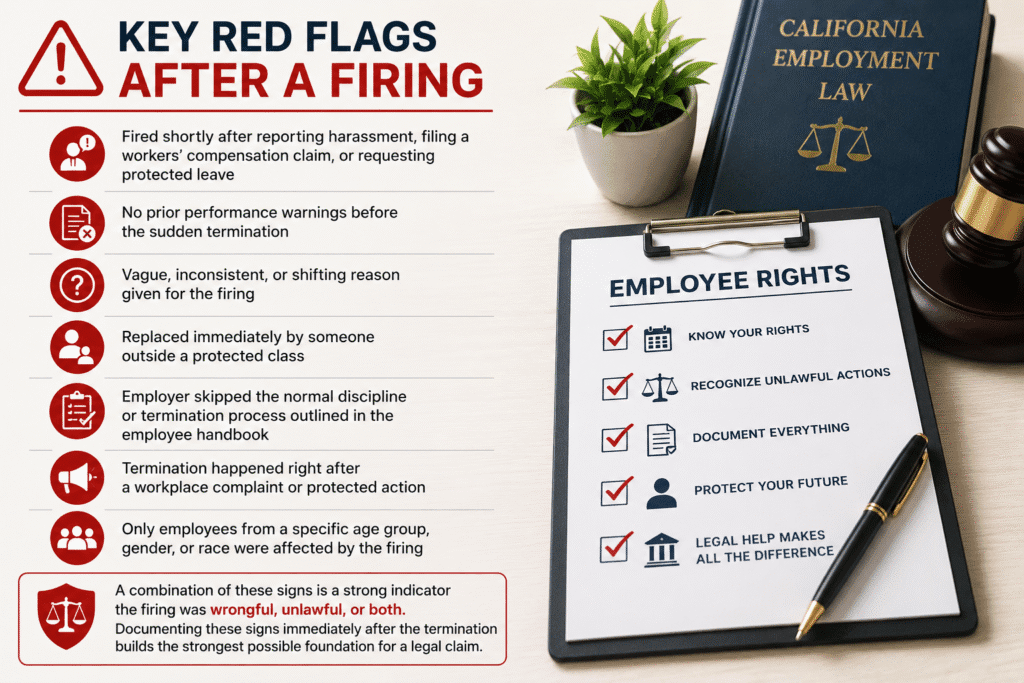
A combination of these signs is a strong indicator the firing was wrongful, unlawful, or both. Documenting these signs immediately after the termination builds the strongest possible foundation for a legal claim.
Real-World Example
Emma worked as an accountant at a financial services firm in Los Angeles for seven years with no performance issues on record. After reporting her manager for wage theft, she was fired two weeks later. The employer cited attitude problems, a complaint that had never appeared in any prior review.
Emma hired a wrongful termination lawyer in Los Angeles and filed a complaint with the CRD. Her clean seven-year performance record and the timing of the termination directly after the wage theft report established a clear retaliation connection. Emma recovered back pay, front pay, and personal distress damages through a settlement reached before trial.
CDV Law Firm offers a 100% free, no-obligation case review. Our team reviews each employment situation and helps workers understand every right they have after a termination.
Steps to Take Immediately After Being Fired
Taking the right steps in the days after a termination protects every available legal right.
- Check the final paycheck immediately: Verify all wages, unused vacation, and commissions are included. Report any errors or delays to an employment lawyer right away.
- File for unemployment benefits through EDD: Apply as early as possible after the termination. Delaying the application risks losing benefit payments that are not retroactive.
- Review COBRA or Cal-COBRA options: Contact the employer’s HR department or benefits administrator to understand health insurance continuation options and costs.
- Do not sign any severance agreement without legal advice: Signing waives the right to file a wrongful termination or retaliation claim. Consult an employment lawyer before putting pen to paper.
- Request the termination reason in writing: Ask the employer to provide a written explanation for the firing and keep a copy of every response received.
- Document everything immediately: Save all emails, performance reviews, HR communications, and any written or verbal communication connected to the termination.
- Note the timeline: Write down every date connected to the firing including any complaint, protected action, or change in treatment that happened before the termination.
- Consult an employment lawyer in California: A lawyer handling wrongful termination and retaliation claims identifies the strongest legal path and ensures no deadlines are missed.
Filing deadlines are strict. Acting quickly after a termination protects every right available under California and federal law.
Compensation Available for Wrongful Termination
Employees winning a wrongful termination claim in California can recover several types of compensation. The goal is to restore every dollar and benefit lost because of the unlawful firing.
Types of Compensation Available
- Back pay: All wages lost from the termination date to the date of settlement or court judgment
- Front pay: Estimated future lost wages if returning to the same or a comparable position is not practical
- Personal distress damages: Compensation for anxiety, psychological suffering, and mental health impact caused by the wrongful firing
- Employer penalty damages: Awarded when the employer acted deliberately, dishonestly, or with serious disregard for the employee’s rights
- Reinstatement: A court order requiring the employer to restore the employee to the original position
Compensation varies based on the strength of evidence, the employee’s salary, and the severity of the employer’s conduct. A wrongful termination attorney in San Diego, Los Angeles, or anywhere in California can review the facts and provide a realistic compensation estimate.
Conclusion
Fired employees in California have strong legal rights covering final pay, health insurance, unemployment benefits, and full protection against wrongful termination. Knowing these rights and acting on them quickly makes the difference between recovering full compensation and missing the legal window entirely.
Employees wrongfully fired in 2026 have a clear path to pursue justice. The key is to act fast, document everything, and get proper legal help before any deadlines pass.
CDV Law Firm offers a 100% free, no-obligation case review online. Our team provides detailed advice based on each employment situation and helps workers understand how to protect their rights. The firm handles wrongful termination claims including:
- Retaliation: Being fired or punished for reporting unsafe conditions, workplace misconduct, or any violation of employee rights
- Discrimination: Being treated unfairly or fired because of race, gender, age, religion, disability, or national origin
- Sexual harassment: Facing unwanted sexual comments, physical advances, or repeated conduct that makes the workplace uncomfortable and hostile
- Wage claims: Not receiving earned wages, having overtime withheld, or not getting a proper final paycheck after termination
Contact CDV Law Firm or call the California offices directly. Our legal team focuses on holding employers accountable and serves clients across California including Los Angeles and San Diego. Fill out the contact form to get a case evaluation with no obligation.
Frequently Asked Questions
What Are My Rights After Being Fired in California?
Do I Get My Final Paycheck on the Last Day in California?
Can I Get Unemployment If I Was Fired in California?
What Is COBRA and Am I Entitled to It After Being Fired?
Can I Sue My Employer for Wrongful Termination in California?
How Long Do I Have to File a Wrongful Termination Claim in California?
Should I Sign a Severance Agreement After Being Fired?
What Counts as Wrongful Termination in California?
LATEST BLOGS

Fired for Requesting Religious Accommodation in California? Know Your Legal Rights

Disability Discrimination and Wrongful Termination in California: Know Your Rights