
Wrongful Termination vs Layoff in California: What Is the Legal Difference?
A layoff is a business decision. Wrongful termination is a firing that breaks the law. Employers in California sometimes label a wrongful termination as a layoff to avoid legal consequences. Employees have the right to challenge a layoff that was actually a wrongful termination and recover full compensation.

What Is a Layoff in California
A layoff is job loss caused by a business reason, not by anything the employee did wrong. The decision is about the position, not the person holding it.
Common business reasons for a layoff include budget cuts, company restructuring, department downsizing, mergers, and company closures. A lawful layoff affects the role, and the employer can demonstrate a genuine business need behind the decision.
California law also requires employers to issue the final paycheck on the last day of employment under Labor Code Section 201. Unused vacation pay must be included in that final paycheck.
The California WARN Act requires employers with 75 or more employees to provide 60 days written notice before a mass layoff affecting 50 or more workers. Failing to give proper notice gives affected employees the right to seek back pay and benefits for the notice period.
What Is Wrongful Termination in California
Wrongful termination happens when an employer fires an employee for a reason that breaks a specific law, violates a contract, or goes against public policy. California follows at-will employment, but that does not give employers the right to fire someone for every reason.
Laws like the California Fair Employment and Housing Act (FEHA), the Americans with Disabilities Act (ADA), and Title VII of the Civil Rights Act set firm limits on termination decisions. A firing that crosses those limits is wrongful termination under California and federal law.
Common Reasons a Termination Is Wrongful
- Fired because of race, gender, age, religion, disability, or national origin
- Fired for reporting harassment or unsafe working conditions to management or a government agency
- Fired for filing a workers’ compensation claim after a workplace injury
- Fired for taking protected medical or family leave under CFRA or FMLA
- Fired in violation of a written or implied employment contract
- Constructive discharge: the employer made working conditions so unbearable the employee had no reasonable choice but to resign
Each of these situations gives the employee the right to file a legal claim and seek compensation for the losses caused by the wrongful firing.
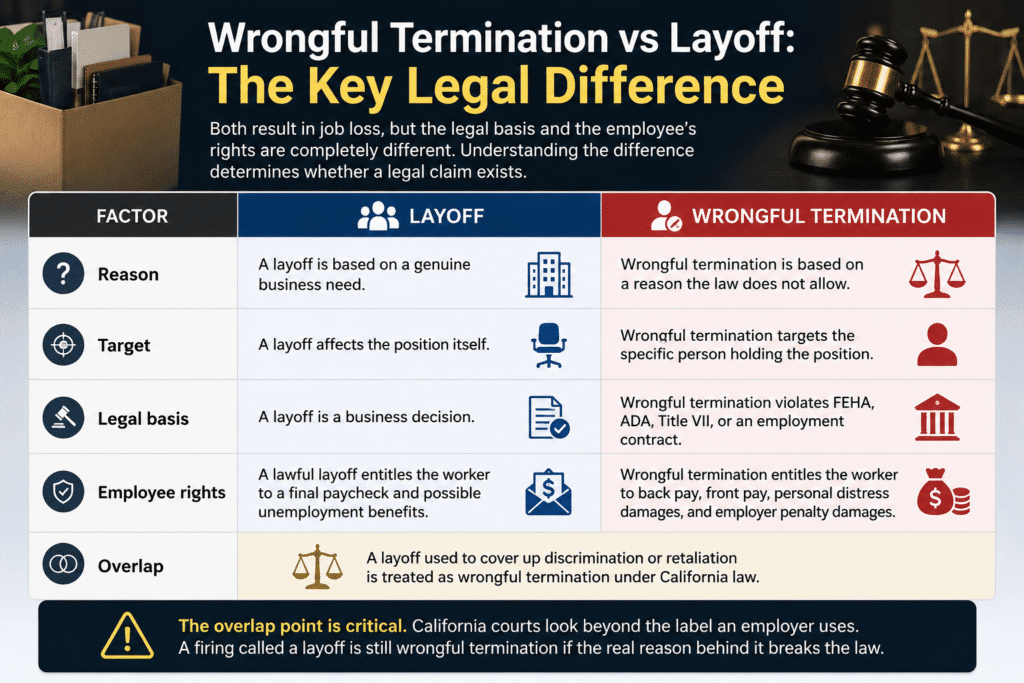
Wrongful Termination vs Layoff: The Key Legal Difference
Both result in job loss, but the legal basis and the employee’s rights are completely different. Understanding the difference determines whether a legal claim exists.
Side by Side Comparison
- Reason: A layoff is based on a genuine business need. Wrongful termination is based on a reason the law does not allow.
- Target: A layoff affects the position itself. Wrongful termination targets the specific person holding the position.
- Legal basis: A layoff is a business decision. Wrongful termination violates FEHA, ADA, Title VII, or an employment contract.
- Employee rights: A lawful layoff entitles the worker to a final paycheck and possible unemployment benefits. Wrongful termination entitles the worker to back pay, front pay, personal distress damages, and employer penalty damages.
- Overlap: A layoff used to cover up discrimination or retaliation is treated as wrongful termination under California law.
When a Layoff Is Actually Wrongful Termination
Employers in California sometimes use a layoff as cover to hide a firing that would otherwise be a clear legal violation. California courts recognize this practice as pretextual discharge.
Pretextual discharge happens when an employer gives a false business reason for a termination to conceal an unlawful motive. The employer calls it restructuring or budget cuts, but the real reason is retaliation, discrimination, or another protected violation.
California law under FEHA and Labor Code Section 1102.5 prohibits employers from disguising retaliation or discrimination as a business decision. Courts examine the timing, the pattern of decisions, and the treatment of comparable employees to determine whether the layoff was genuine.
Signs a Layoff Was Actually Wrongful Termination
- Only employees from a specific protected group were laid off while others in similar roles kept their jobs
- The employee was replaced shortly after the supposed position was eliminated
- The layoff happened right after a complaint, a protected leave request, or a workers’ compensation claim
- The employer excluded the affected employee from severance offered to others in similar positions
- No genuine company-wide financial difficulty existed at the time of the layoff
- The employer gave a vague or shifting reason for why that specific employee was selected for the layoff
- The timing of the layoff closely followed a protected action taken by the employee
Any one of these signs is worth investigating. A combination of these signs is a strong indicator the layoff was used to cover up a wrongful termination.
Employee Rights During a Lawful Layoff in California
Even a lawful layoff comes with legal protections. Employees let go through a genuine business decision still have rights that employers must respect.
- Final paycheck: Must be issued on the last day of employment under California Labor Code Section 201. Delayed final pay gives the employee the right to penalty wages.
- Unused vacation pay: Must be included in the final paycheck. California law treats earned vacation as wages that cannot be forfeited.
- California WARN Act notice: Employers with 75 or more employees must provide 60 days written notice before a qualifying mass layoff. Failure to give notice entitles affected employees to back pay and benefits for the notice period.
- Unemployment benefits: Employees laid off for business reasons are generally eligible to file for unemployment benefits through the California Employment Development Department (EDD).
- Severance agreements: Employers sometimes ask laid-off employees to sign a severance agreement in exchange for additional pay. Signing waives the right to sue for wrongful termination. An employee should never sign without consulting an employment lawyer first.
That last point is critical. Signing a severance agreement before speaking to a lawyer can permanently close the door on a valid legal claim
How to Tell If a Termination Was a Layoff or Wrongful Termination
The difference is not always obvious at the time of the job loss. Asking the right questions helps identify whether a legal claim exists.
Key Questions to Ask
- Was the termination connected to a protected action like a complaint, a leave request, or a workers’ compensation claim?
- Were only employees from a specific age group, gender, race, or other protected class affected by the layoff?
- Did the employer follow normal layoff procedures including proper notice, severance, and documentation?
- Was the position truly eliminated or filled by someone else shortly after the layoff?
- Did the employer provide a vague or inconsistent explanation for why that specific employee was selected?
- Did the timing of the layoff closely follow a complaint or protected activity?
A yes answer to any of these questions is a signal worth pursuing with an employment lawyer. A yes answer to several of these questions is a strong sign the layoff was a pretextual wrongful termination
Real-World Example
James worked at a tech company in San Diego for six years with a clean performance record. After filing a harassment complaint against his manager, his employer announced a department restructuring three weeks later. James was the only employee in his department who lost his job.
James hired a wrongful termination attorney in San Diego and filed a complaint with the California Civil Rights Department. Records showed no other positions in the department were eliminated and that a new hire filled a role similar to James’s position two months later. The timing and the pattern established that the layoff was a pretext for retaliation. James recovered back pay, front pay, and personal distress damages through a settlement reached before trial.
CDV Law Firm offers a 100% free, no-obligation case review. Our team reviews each situation carefully and helps workers understand whether a layoff was actually a wrongful termination. Do not sign any severance agreement before speaking to our team.
What to Do If a Layoff Was Actually Wrongful Termination
Taking the right steps immediately after a suspicious layoff protects all available legal rights.
- Do not sign any severance agreement without legal advice: Signing waives the right to file a wrongful termination claim. An employment lawyer must review the agreement before any signature.
- Document everything immediately: Save the layoff notice, emails, performance reviews, HR communications, and any messages connected to the job loss.
- Note the timeline: Write down the dates of any complaint, protected leave request, or workers’ compensation claim filed before the layoff. The connection between these dates and the layoff date is key evidence.
- File a complaint with the right agency: For discrimination or retaliation claims, file with the California Civil Rights Department (CRD). For federal claims, file with the EEOC. FEHA claims must be filed within three years of the violation.
- Consult an employment lawyer in California: A lawyer handling wrongful termination claims identifies whether the layoff was pretextual and builds the strongest possible case.
- Track all financial losses: Document lost wages, lost benefits, and any costs tied to the job loss from the layoff date forward.
Acting fast is essential. Filing deadlines are strict and missing one can permanently close a legal claim.
Compensation Available If a Layoff Was Wrongful Termination
Winning a wrongful termination claim after a pretextual layoff can result in several types of compensation. The goal is to restore every dollar and benefit lost because of the wrongful job loss.
Types of Compensation Available
- Back pay: All wages lost from the layoff date to the date of settlement or court judgment
- Front pay: Estimated future lost wages if returning to the same or comparable position is not practical
- Personal distress damages: Compensation for anxiety, psychological suffering, and mental health impact caused by the wrongful job loss
- Employer penalty damages: Awarded when the employer acted deliberately or dishonestly in disguising the termination as a layoff
- Reinstatement: A court order requiring the employer to restore the employee to the original position
Compensation varies based on the strength of evidence, the employee’s salary, and the severity of the employer’s conduct. An employment attorney in California can review the facts and provide a realistic estimate of the total compensation available.
Conclusion
A layoff and a wrongful termination are not the same thing, and the label an employer uses does not determine the legal outcome. California courts look at the real reason behind a job loss, not just what the employer calls it.
Employees in California in 2026 facing a suspicious layoff have strong legal rights and a clear path to pursue compensation. The key is to act quickly, avoid signing anything without legal advice, document everything, and get proper legal help right away.
CDV Law Firm offers a 100% free, no-obligation case review online. Our team provides detailed advice based on each employment situation and helps workers understand how to protect their rights. The firm handles wrongful termination and layoff-related claims including:
- Retaliation: Being fired or laid off as punishment for reporting unsafe conditions, workplace misconduct, or any violation of employee rights
- Discrimination: Being selected for layoff or termination because of race, gender, age, religion, disability, or national origin
- Sexual harassment: Facing unwanted sexual comments, physical advances, or repeated conduct that makes the workplace uncomfortable and hostile
- Wage claims: Not receiving earned wages, having overtime withheld, or not getting a proper final paycheck after a layoff or termination
Contact CDV Law Firm or call the California offices directly. Our legal team focuses on holding employers accountable and serves clients across California including Los Angeles and San Diego. Fill out the contact form to get a case evaluation with no obligation
Frequently Asked Questions
What Is the Difference Between a Layoff and Wrongful Termination in California?
Can a Layoff Be Considered Wrongful Termination?
How Do I Know If My Layoff Was Actually Wrongful Termination?
What Are My Rights If I Was Laid Off in California?
Can I Sue If My Layoff Was Used to Cover Up Discrimination?
Should I Sign a Severance Agreement After a Layoff?
How Long Do I Have to File a Wrongful Termination Claim After a Layoff?
What Compensation Can I Get If My Layoff Was Wrongful Termination?
LATEST BLOGS

Fired for Requesting Religious Accommodation in California? Know Your Legal Rights

Disability Discrimination and Wrongful Termination in California: Know Your Rights